














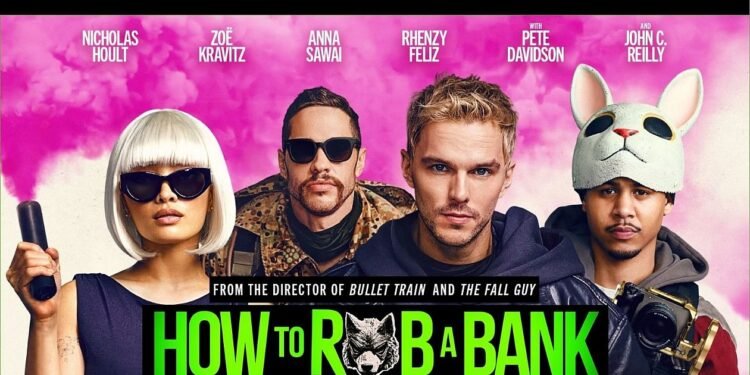

David Leitch delivers a stylish, entertaining heist film with a fantastic ensemble, but familiar storytelling and uneven pacing keep it from reaching its full potential.

There’s something incredibly satisfying about a good heist movie, especially when you find yourself rooting for the people committing the crimes. David Leitch’s How to Rob a Bank takes that familiar formula and gives it a modern spin, delivering an entertaining ride that feels like The Italian Job meets Den of Thieves for an online generation that’s ready to say screw you to the corporations and institutions that have failed them. Throw in a little Robin Hood mentality, a fantastic ensemble cast, and some genuinely hilarious moments, and there’s plenty here to enjoy. Unfortunately, despite its clever premise and energetic presentation, the film struggles to maintain its momentum, relying on familiar genre clichés and an unnecessarily drawn-out story that keeps it from becoming something truly memorable.
Set in Pittsburgh, the film follows Ryan (Nicholas Hoult) and his crew of bank robbers, who have turned their crimes into viral online spectacles. Wearing animal masks to conceal their identities, the group films their elaborate robberies and shares the footage online, quickly gaining an audience that sees them as something closer to modern-day folk heroes than criminals. Each member of the crew has been personally hurt by a system that was supposed to protect them, and their motivations go beyond simply wanting to get rich. They’re people who have been pushed to their limits and have decided they’re done playing by the rules.
It’s a genuinely fun concept, especially in an era where social media has the power to turn practically anyone into an overnight sensation. However, while the film finds some clever ways to incorporate modern technology into the genre, the story itself doesn’t necessarily offer anything we haven’t seen before.

A Fantastic Ensemble Worth Rooting For
Nicholas Hoult leads the charge as Ryan, the group’s de facto leader, and once again proves why he’s one of the most versatile actors working today. Hoult brings a combination of charisma, intensity, and vulnerability to the role, creating a character who’s clearly carrying a tremendous amount of pain beneath his confidence. There’s a nuance to his performance that makes Ryan much more than another criminal mastermind with an elaborate plan. You understand that everything he’s doing comes from a deeply personal place, and Hoult makes you feel the weight of that motivation throughout the film.
One of the biggest surprises, however, is Pete Davidson, who might have delivered one of the best performances of his career as Vince, an Iraq War veteran and the crew’s weapons expert. Davidson is absolutely hilarious, bringing his familiar comedic timing to the film, but what impressed me most was how much emotion he brings to the character. Vince is someone who has clearly been through a tremendous amount, and there’s a sadness beneath his humor that makes him incredibly compelling to watch.
Davidson has always been capable of making people laugh, but here he gets the opportunity to show something more. His character’s experiences and struggles give him a depth that I wasn’t necessarily expecting, and Davidson does a fantastic job navigating between the comedy and the heavier material. It’s a performance that allows him to be funny without reducing Vince to comic relief, and I genuinely hope we continue to see him take on more roles like this.
Anna Sawai plays Emi, Ryan’s wife and the group’s getaway driver, and she continues to impress with every project she’s involved in. Sawai brings strength and emotional depth to the role, particularly through her relationship with Ryan, which adds another personal dimension to the crew’s motivations. Their shared history plays an important part in understanding why they’ve chosen this path, and Sawai makes the most of those emotional moments.
Rhenzy Feliz is equally enjoyable as Hugo, the group’s social media expert, who helps turn their robberies into viral sensations. Hugo brings a fun, youthful energy to the crew, but his motivations are also grounded in his desire to help his family. Feliz does a great job balancing that enthusiasm with the character’s personal circumstances, making him another member of the group you can’t help but root for.
What makes this ensemble work so well is that each character has something at stake beyond the money. Their experiences might be different, but they’re united by the feeling that the system has failed them. That shared frustration gives the group a common purpose, even when the screenplay doesn’t always give their individual stories the attention they deserve.

John C. Reilly and Zoë Kravitz Are an Unexpected Highlight
While the crew is busy becoming an online sensation, FBI agent John West (John C. Reilly) is tasked with tracking them down. To do so, he enlists the help of Reagan Gardner (Zoë Kravitz), a talented hacker whose surveillance algorithm might be the key to identifying the criminals behind the masks.
I wasn’t expecting John C. Reilly and Zoë Kravitz to become one of my favorite parts of this movie, but their chemistry is fantastic. On paper, they’re such an unusual pairing, yet somehow their completely different personalities complement each other perfectly. Reilly brings his signature dry humor and exasperated energy, while Kravitz plays off him with a sharp wit and confidence that makes their interactions genuinely entertaining.
Their banter is hilarious, and I loved watching these two characters from completely different worlds attempt to work together. There’s an entertaining contrast between Reilly’s old-school approach to investigating and Kravitz’s understanding of the digital world, which fits perfectly with the film’s larger themes about generational differences and technology.
What’s especially fun is that I found myself enjoying their scenes just as much as the ones involving the heist crew. Usually, in movies like this, you’re waiting for the story to return to the criminals because they’re the more entertaining characters. Here, I was equally invested in what was happening on both sides of the investigation. Reilly and Kravitz have such an unexpectedly enjoyable dynamic that I genuinely want to see them work together again. Give these two another movie because I would absolutely be there.

A Clever Social Media Twist and an Immersive Setting
One of the things I appreciated most about How to Rob a Bank is just how cleverly it incorporates social media into the traditional heist formula. We’ve seen countless movies about criminals robbing banks, but the decision to turn these robberies into viral online spectacles is genuinely clever. Operating under the name Who’s Hungry?, Ryan and his crew aren’t just stealing money; they’re building an audience, creating a movement, and using the very platforms that dominate our everyday lives to turn themselves into modern-day Robin Hoods. Their videos are filled with flashy editing, graphics, and an almost rebellious energy that makes their crimes feel like something you’d stumble across while scrolling through social media.
What makes this approach so effective is that we, as viewers, almost become part of that audience ourselves. There’s an infectious excitement surrounding their videos and the public’s reaction to them that makes you feel like you’re participating in this world rather than simply watching it unfold. The use of GoPros, different camera angles, and the film’s energetic visual presentation help create that immersion, blurring the line between watching a fictional heist and experiencing the kind of viral content that dominates our feeds. It’s easily one of the film’s strongest creative decisions, and I wish the rest of the story had been as inventive as its approach to social media.
The Pittsburgh setting only adds to that experience. I absolutely loved how the city was incorporated into the story, giving the film a distinct personality and making the world feel authentic and lived-in. There’s something fitting about setting a story centered on working-class frustrations and financial inequality in a city with such a strong industrial history. The locations, streets, and overall atmosphere contribute to the sense that these robberies are happening in a recognizable world where people are struggling to get by and looking for someone willing to challenge the system.
There’s also something satisfying about the film’s rebellious attitude toward corporate greed and financial institutions. These characters represent people who have worked hard, made sacrifices, and still found themselves struggling to get ahead. Christian Slater’s portrayal of the ruthless banker Mr. Walton gives that frustration a recognizable face, representing the kind of institutional greed that has pushed Ryan and Emi to their breaking point. While the film doesn’t necessarily explore its larger social commentary as deeply as it could, the anger driving these characters is easy to understand.
David Leitch knows how to make all of this entertaining. Having previously directed Bullet Train and The Fall Guy, he’s proven that he understands how to balance action, comedy, and charismatic characters, and that experience is evident throughout. The robberies have plenty of energy, the humor works, and the film’s vibrant presentation gives it a playful personality. Unfortunately, while Leitch finds inventive ways to present the story, the screenplay doesn’t always match that creativity.

A Familiar Formula That Eventually Runs Out of Steam
Unfortunately, as much as I enjoyed the cast, the setting, and the film’s approach to social media, How to Rob a Bank starts to lose momentum as the story progresses. The opening does a fantastic job establishing the crew, their motivations, and the increasingly elaborate robberies, but somewhere around the middle, the pacing begins to drag. What initially feels like a fast-moving and energetic heist movie starts spending too much time getting to its destination, and the excitement that made the first half so enjoyable becomes harder to maintain.
There was even a point where I genuinely thought the movie was over, only for it to keep going. That’s never a particularly great feeling when you’re watching a film that relies so heavily on momentum, and it highlights one of the screenplay’s biggest problems. There are moments where the story feels like it’s building toward a natural conclusion, but instead of wrapping things up, it continues stretching out the narrative. By the time the actual ending arrives, some of that initial excitement has worn off.
The other issue is just how familiar so much of the material feels. For all its clever ideas involving social media and online fame, the film still falls back on many of the same clichés we’ve seen in countless other heist movies. From the tragic backstories motivating the criminals to the familiar cat-and-mouse dynamic between the robbers and law enforcement, there isn’t much here that genuinely pushes the genre forward. Even the film’s larger commentary on corporate greed and financial inequality, while relevant, never quite develops into something as meaningful as its premise suggests.
That’s not to say every heist movie needs to reinvent the wheel. Sometimes a familiar formula executed well is more than enough, and there are plenty of moments where How to Rob a Bank succeeds on pure entertainment value. But when a film introduces such an interesting concept, you naturally hope it’s going to take those ideas somewhere unexpected. Instead, it occasionally feels like two different movies competing for attention: an inventive, social media-driven crime caper and a much more conventional heist thriller.
It’s especially frustrating because there’s a genuinely great movie somewhere in here. The cast is fantastic, the setting is immersive, and the social media angle is one of the more entertaining ways I’ve seen the genre updated for modern audiences. A tighter screenplay and a more focused second half could have made a significant difference. As it stands, the film is entertaining enough to recommend, but it never quite reaches the heights its premise promises.
Final Thoughts
How to Rob a Bank is an entertaining but ultimately uneven addition to the heist genre. David Leitch delivers plenty of action, humor, and personality, while the film’s clever use of social media and its immersive Pittsburgh setting help distinguish it from other entries in the genre. Unfortunately, an overextended middle section, a story that seems to keep going long after you expect it to end, and an abundance of familiar clichés prevent it from reaching its full potential.
Nicholas Hoult is fantastic as the group’s emotionally wounded leader, Pete Davidson delivers one of his strongest performances, and Anna Sawai and Rhenzy Feliz help create a crew whose personal struggles make them easy to root for. Meanwhile, John C. Reilly and Zoë Kravitz are an absolute delight together, bringing some of the film’s funniest and most enjoyable moments.
It’s The Italian Job meets Den of Thieves with a little Robin Hood thrown into the mix, reimagined for an online generation that’s tired of being taken advantage of. I just wish the film had been willing to take more risks with its storytelling instead of relying so heavily on a formula we’ve seen countless times before.
Still, despite its flaws, there’s enough entertainment here to make it worth a watch. The performances are strong, the concept is fun, and when the film is firing on all cylinders, it’s a genuinely good time. It might not pull off the perfect heist, but there’s enough here to walk away satisfied.
Rating: 3 Seth’s out of 5