















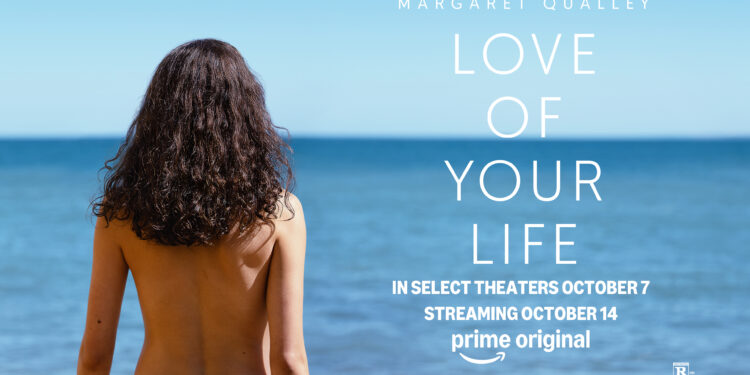


As you probably know by now, I’m a massive romance fan. Horror may always be my favorite genre, but I have to mix things up every once in a while, and dramas and romances are where my other allegiance lies. Last year’s TIFF gave me my favorite film of the year with Eternity, so naturally, I was beyond excited to see what this year’s slate had to offer when it came to romance and romantic dramas.
One film immediately caught my attention: Love of Your Life.
Directed by Rachel Morrison and starring Margaret Qualley, Love of Your Life quickly became one of my most anticipated films of TIFF. It’s the kind of sweeping romantic drama that sounds right up my alley, but what Morrison has crafted is about much more than simply finding love. It’s about grief, guilt, regret, and ultimately finding a way to allow yourself to live again.
The film follows Maya (Qualley), a 26-year-old nurse in Boston who falls in love with Charlie (Gabriel Basso). Their relationship moves quickly, and the two eventually marry, only for their lives to be completely upended by the arrival of the COVID-19 pandemic.
Maya eventually flees the life she knew in the United States, cutting herself off from nearly everyone, including her best friend Jason (Patrick Schwarzenegger). She becomes a digital nomad in Portugal, where she meets Felix (Aaron Pierre), whose presence begins to awaken something in Maya she has seemingly buried. Their connection eventually takes her to England, but no matter how far Maya travels or how many times she attempts to reinvent herself, she can’t completely escape the ghosts of her past.
The performances are what elevate Love of Your Life the most, and there is just something about Margaret Qualley that demands your attention every second she is on screen. She has an ability to communicate an incredible amount without saying much at all. You can feel every bit of grief, shame, joy, and uncertainty Maya carries with her.
Qualley even worked with real nurses to prepare for the role, and that commitment helps transport us back to one of the darkest periods in recent history. But it’s the emotional journey beyond Maya’s profession that gives Qualley so much to work with. Maya isn’t simply grieving. She’s trying to figure out who she is after grief has fundamentally changed her.
That idea sits at the heart of Morrison’s film.
Morrison has spoken about the idea that deep gratitude can follow deep grief, something she knows firsthand from her own experiences with loss. She has also discussed how the tremendous losses in her own life have been balanced by equally immense amounts of love and life energy.
You can feel those ideas throughout Love of Your Life.
Grief comes in so many different forms, and there isn’t necessarily a right or wrong way to navigate it. Sometimes it makes us retreat. Sometimes it makes us hurt the people who care about us. Sometimes we convince ourselves that because of what happened, or because of the mistakes we made afterward, we no longer deserve happiness.
Love of Your Life pushes back against that idea.
It’s a film about cherishing what we have while remembering the beautiful moments that came before. Our tragedies and mistakes don’t have to define the rest of our lives. Loss doesn’t simply disappear, but neither does our capacity to love, change, or experience happiness again.
Not everything completely worked for me, though. I do wish the COVID storyline wasn’t quite as central to the film. I lived through that period, and after years of movies, television, documentaries, and countless conversations revisiting the pandemic, using it as such a major vehicle for the story’s themes occasionally made the film feel like it was arriving several years too late.
Thankfully, that wasn’t enough to take away from how affecting I found the film overall.
At its best, Love of Your Life understands that moving forward doesn’t mean forgetting what happened or pretending the loss no longer hurts. The grief, shame, and regret we harbor don’t have to put a nail in the coffin of the life we still have left to live.
The loss may always be there. The memories will always be there. But so will the possibility of something new.
We can keep living.
We can love again.
And we still deserve to be happy.
3.5 Seths out of 5