









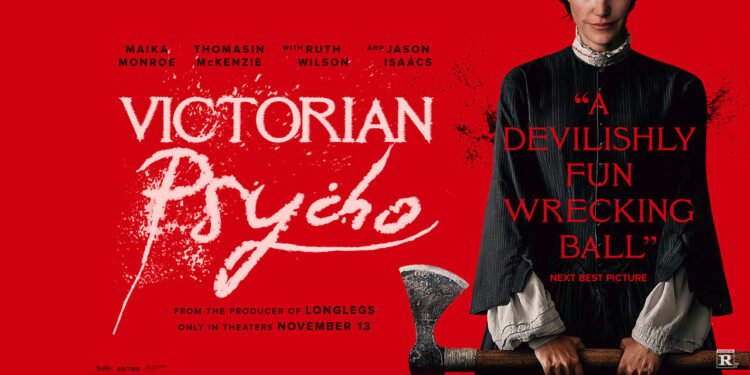


Maika Monroe trades scream queen for cold-blooded killer in a wickedly entertaining Victorian horror comedy that’s as stylish as it is bloody.
Maika Monroe has done it yet again. Over the past decade, she’s cemented herself as one of the most exciting actresses working in horror, delivering unforgettable performances in films like It Follows, Watcher, and Longlegs. But in Victorian Psycho, she trades her usual role of confronting evil for the opportunity to become it, and the results are an absolute blast. This time around, Monroe gets to unleash a completely different side of herself, delivering what might be her most entertaining and delightfully unhinged performance to date.
I had the opportunity to catch Victorian Psycho early at Fantastic Fest, and it quickly became one of my favorite watches of the festival. Directed by Zachary Wigon and adapted by Virginia Feito from her novel, the film is a wickedly twisted period horror comedy that takes the elegance and rigid social expectations of Victorian England and turns them into a playground for murder, madness, and dark humor. It isn’t without its flaws, but between its wonderfully deranged central performance, stylish direction, and willingness to embrace the absurd, there’s plenty here for horror fans to sink their teeth into.

A Governess With a Deadly Secret
Set in 1858, Victorian Psycho follows Winifred Notty (Maika Monroe), a mysterious young woman who arrives at Ensor House, a sprawling Gothic estate on the Yorkshire Moors, to serve as governess to the two children of the wealthy Pounds family. Mr. and Mrs. Pounds, played by Jason Isaacs and Ruth Wilson, welcome Winifred into their home, seemingly unaware of the darkness lurking beneath her carefully maintained exterior.
Winifred presents herself as an intelligent, composed, and respectable young woman, but it doesn’t take long to realize that something is very wrong. Her unusual teaching methods, disturbing fascination with morality, and increasingly bizarre behavior suggest that the Pounds family may have made a terrible mistake in bringing her into their home. As members of the household begin disappearing and tensions escalate, Winifred’s carefully constructed facade starts to unravel, revealing a woman whose relationship with violence is anything but ordinary.
What makes the premise so entertaining is that the film never really attempts to hide Winifred’s true nature from the audience. We know almost immediately that she’s dangerous, and rather than building its tension around discovering who she really is, the film invites us to sit back and watch just how far she’s willing to go. There’s a mischievous quality to the storytelling that makes even the most disturbing moments feel strangely playful, creating an experience that is as darkly comedic as it is horrific.
Maika Monroe Steals the Show
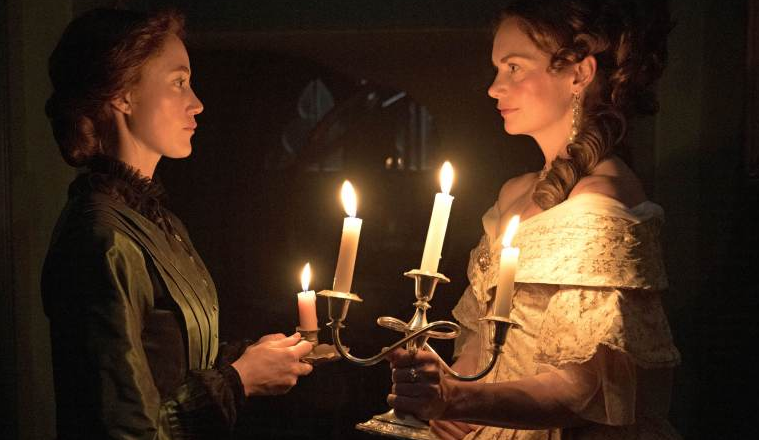
If there’s one reason to see Victorian Psycho, it’s Maika Monroe. We’ve watched her spend years playing characters who are forced to confront terrifying situations, often relying on their intelligence, determination, and instincts to survive. Here, she gets to flip that dynamic entirely, stepping into the role of the very thing her previous characters would have been running from.
One of my favorite things about horror is getting to watch the genre’s beloved scream queens step outside the roles we’ve come to associate with them and embrace the madness themselves. There’s something incredibly satisfying about watching an actress who has spent years running from killers finally get to be the one doing the killing, especially when she gets to go all out and end up covered in blood. Monroe clearly understood the assignment, and watching her embrace this methodical, murderous character with such enthusiasm was an absolute delight.
What impressed me most about Monroe’s performance is just how effortlessly she portrays Winifred’s calculated madness. This isn’t simply a character who loses control and lashes out without thinking. There’s a methodical quality to the way Winifred operates, and Monroe understands exactly how to balance that calculated behavior with the character’s more unpredictable tendencies. Whether she’s maintaining a perfectly composed expression during an uncomfortable conversation or revealing just how twisted her thoughts have become, Monroe commands your attention every time she’s on screen.
While Longlegs showcased her ability to portray fear, vulnerability, and determination, Victorian Psycho allows her to embrace a much more theatrical and mischievous performance. She isn’t afraid to make Winifred bizarre, unsettling, or even ridiculous at times, and that willingness to fully commit to the character is what makes the performance so memorable. There’s an almost theatrical quality to her physicality and facial expressions, as though she’s constantly balancing the respectable woman she’s pretending to be with the monster lurking underneath.
What makes Winifred particularly fascinating is that she isn’t simply a woman pushed to the edge by her circumstances. She’s someone who appears to have made peace with her own darkness, even finding a strange sense of comfort in it. Monroe plays that duality beautifully, shifting between moments of eerie composure and bursts of outrageous behavior without ever losing sight of the character’s twisted perspective.
It’s a side of Monroe that we haven’t really gotten to experience before, and I genuinely hope we see more of it in the future. This is undoubtedly the Maika Monroe show, and she’s having an absolute blast.
A Strong Supporting Cast and a World Built on Repression
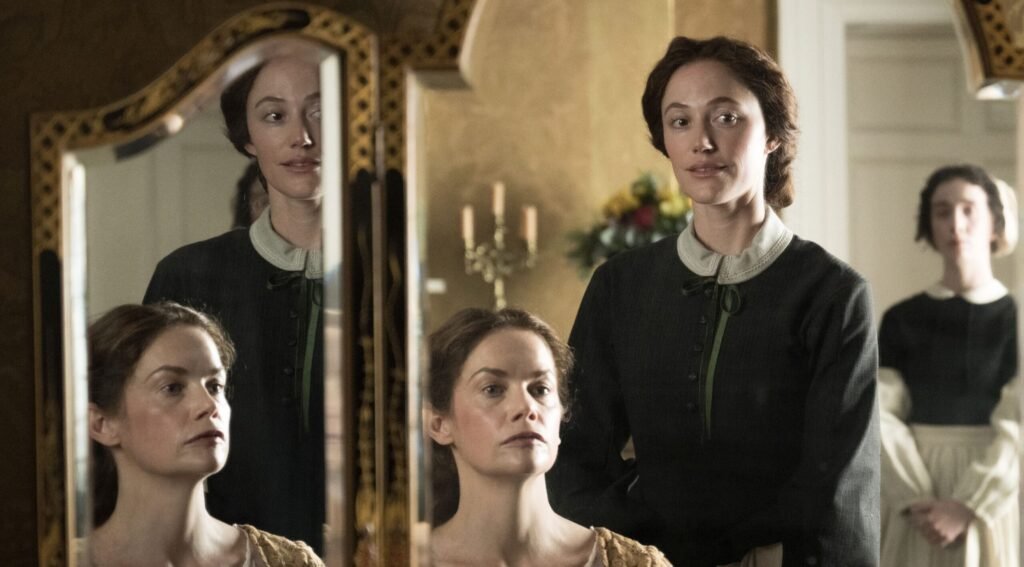
Although Monroe is unquestionably the film’s biggest attraction, the supporting cast does a fantastic job bringing this peculiar world to life. Jason Isaacs is great as always, delivering another memorable performance as Mr. Pounds that fits perfectly within the film’s eccentric atmosphere. Ruth Wilson brings a particularly cold and commanding presence to Mrs. Pounds, embodying the strict expectations and social conventions that define the family’s existence. Her character represents a different kind of cruelty, one rooted in power, privilege, and the belief that maintaining appearances is more important than compassion.
Thomasin McKenzie is another welcome addition as Miss Lamb, a fellow servant working within the household who develops an increasingly interesting relationship with Winifred. I really enjoyed watching their dynamic unfold as the film progressed, especially with how differently the two women approach the strange circumstances surrounding them. McKenzie brings a certain innocence and warmth to the role that plays wonderfully against Monroe’s more unpredictable and sinister personality. Their interactions add another entertaining layer to the story, and it’s a relationship I found myself becoming increasingly invested in.
I also have to mention Evie Templeton as Drusilla Pounds, the family’s rather spoiled and entitled daughter. She’s exactly the kind of character you would expect to find growing up in a household like this, but what makes her particularly entertaining is watching how she changes throughout the film. Her interactions with Winifred become increasingly interesting as the story progresses, and Templeton does a great job bringing that transformation to life. It’s another example of how the film has fun with its characters rather than simply leaving them exactly where they started.
The supporting performances also help reinforce one of the film’s more interesting underlying ideas: the suffocating expectations placed upon women during the Victorian era. The Pounds household operates within a world governed by appearances, social standing, and rigid expectations of proper behavior. Women are expected to remain obedient and respectable, while men are afforded considerably more freedom. Beneath the beautiful costumes and elaborate interiors lies a society built on repression, inequality, and the expectation that everyone should know their place.
There’s something darkly satisfying about watching a character like Winifred disrupt a world so obsessed with maintaining the illusion of perfection. However, the film never attempts to portray her as some misunderstood heroine fighting against injustice. Winifred is genuinely dangerous, and her violent impulses extend far beyond any reasonable response to the society surrounding her. That distinction makes her far more interesting, allowing the film to explore its themes without attempting to justify every terrible thing she does.

Bloodshed, Dark Humor, and a Beautifully Twisted Victorian World
One of the most distinctive elements of Victorian Psycho is its commitment to blending period drama with pitch-black comedy and horror. Rather than approaching its subject matter with complete seriousness, the film embraces the absurdity of its premise, finding humor in the most uncomfortable situations and allowing its characters to behave in ways that are both disturbing and unexpectedly funny.
There’s a gleeful nastiness to the way Victorian Psycho approaches its bloodshed, often treating acts of brutality with an almost casual disregard for human life. That attitude becomes part of the film’s identity, creating a world where even the most shocking acts can be followed by moments of absurd humor. It’s the kind of outrageous horror that isn’t necessarily interested in making audiences comfortable, and I appreciated its willingness to push boundaries rather than play things safe.
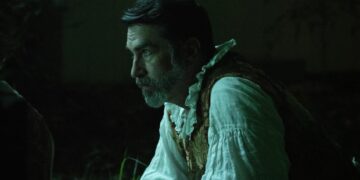
One aspect of the film I absolutely loved was the world Wigon and his team created. The production design and costumes are fantastic, and there’s so much personality in the way this Victorian setting is brought to life. From the sprawling Gothic estate and its elaborate interiors to the beautifully detailed period clothing, everything feels carefully constructed to immerse you in this world. There’s an elegance to the setting that makes the increasingly outrageous events unfolding within it that much more entertaining. I loved that contrast between the polished, respectable appearance of the Pounds household and the absolute madness taking place behind closed doors.
The costume design is especially fun because it plays such an important role in establishing the personalities and social standing of these characters. There’s something visually striking about watching all this bloodshed unfold against such beautiful clothing and lavish surroundings. The film looks and feels like a prestige period drama at times, only to remind you moments later that you’re watching something far more twisted. That combination is a huge part of its charm, and I found myself constantly appreciating the attention to detail throughout the production.
Cinematographer Nico Aguilar also deserves recognition for the film’s distinctive visual style. The camera frequently moves in unexpected ways, giving otherwise ordinary objects and moments a strange sense of importance while reflecting Winifred’s increasingly disturbed perspective. Combined with the atmospheric lighting and unsettling sound design, these stylistic choices help create a world that feels both elegant and deeply unhinged.
Wigon clearly has a particular vision for this material, and I appreciated how much personality he brings to the filmmaking. Even when the story doesn’t always find the right balance, the film remains visually engaging, and the contrast between its refined Victorian presentation and grotesque subject matter is one of its greatest strengths.

An Entertaining Ride That Occasionally Loses Its Balance
As much as I enjoyed Victorian Psycho, there were moments when I felt the film struggled to maintain a consistent tone. Its blend of dark comedy, psychological horror, and social commentary is certainly ambitious, but not every element comes together as smoothly as it should. At times, the film leans so heavily into its absurdity that it undercuts the tension it has spent time establishing, while other moments feel considerably more serious than the scenes surrounding them.
That unpredictability is clearly intentional to some extent, especially considering the unstable perspective through which we’re experiencing the story. However, there were instances where I found myself wishing the film would settle into a more cohesive rhythm. The humor can be wonderfully twisted when it lands, but there are also moments when the exaggerated behavior and increasingly outrageous situations feel like they’re competing for attention rather than complementing one another.
The pacing also becomes a little uneven as the story progresses. While the film starts strong and establishes its central premise relatively quickly, there are stretches where the narrative loses some of its momentum. The story itself isn’t always as compelling as Monroe’s performance, and certain developments don’t carry quite the impact they seem intended to have. I occasionally found myself wishing the film would tighten things up and lean further into the elements that were working so well.
Thankfully, those issues never completely derail the experience. Even when the storytelling loses a bit of focus, Monroe remains such an entertaining presence that it’s difficult not to stay invested in what she’s going to do next. Her performance provides the film with a consistent source of energy, and the sheer audacity of some of its creative choices makes it easy to forgive a few narrative missteps.
Final Thoughts: A Bloody Good Time at Fantastic Fest
Despite its occasional pacing issues and uneven tonal shifts, Victorian Psycho ended up being one of my favorite experiences at Fantastic Fest. It’s a delightfully strange, wickedly funny, and unapologetically twisted horror comedy that understands the appeal of putting a talented performer at the center of absolute chaos.
More than anything, the film serves as another reminder of just how versatile Maika Monroe has become. After spending years establishing herself as one of the genre’s most recognizable heroines, she proves that stepping into the role of a calculating, murderous governess can be just as compelling. There’s a confidence and playfulness to her performance that makes Winifred Notty one of her most entertaining characters to date.
I would have loved a slightly tighter narrative and a more consistent balance between the film’s competing tones, but those shortcomings did little to diminish how much fun I had watching it. Between its wonderfully deranged central performance, strong supporting cast, stylish direction, and deliciously morbid sense of humor, Victorian Psycho delivers the kind of unconventional horror experience that makes festivals like Fantastic Fest so enjoyable.
If this is what happens when Maika Monroe gets to play the villain, I sincerely hope it isn’t the last time. Sometimes there’s nothing more satisfying than watching one of horror’s favorite scream queens trade survival for slaughter, and Victorian Psycho gives Monroe the opportunity to do exactly that. If you’re looking for a wickedly entertaining horror film, Victorian Psycho is one worth experiencing on the big screen.
Victorian Psycho is now playing in theaters.
Final Rating: 4 Seth’s out of 5